- Your cart is empty
- Continue Shopping


Lorazepam vs Diazepam: What’s the Difference?
- Anxiety & Mental Health
- Posted on
-
by pharm_product
- 0 comments
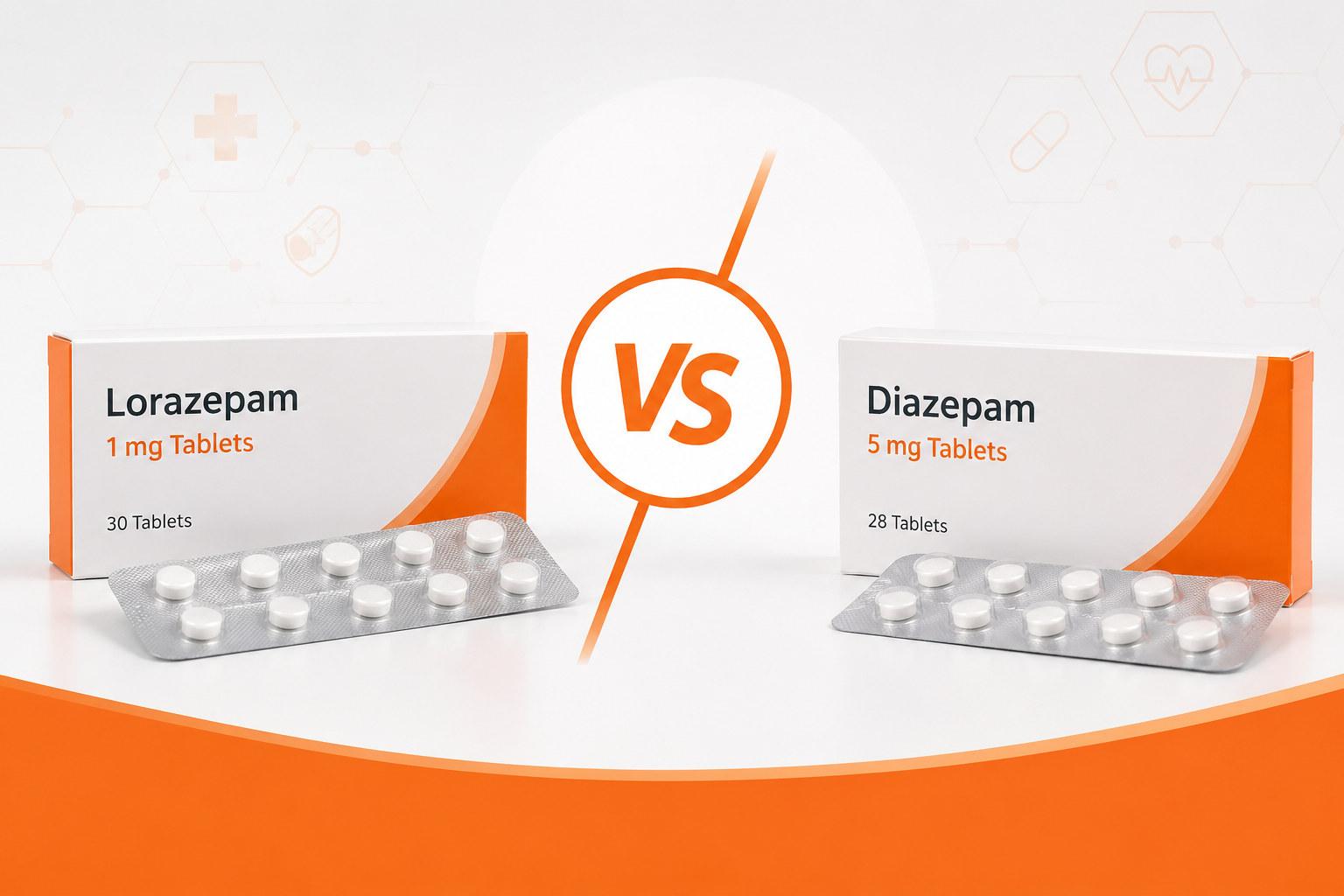
When it comes to prescription medications for anxiety, stress, muscle spasms, and certain neurological conditions, Lorazepam and Diazepam are two of the most commonly prescribed medicines in the UK. Both belong to the benzodiazepine family and work in similar ways, but they are not interchangeable. They differ in how quickly they take effect, how long they remain active in the body, and the medical conditions they are most commonly used to treat.
Understanding these differences can help you have a more informed discussion with your GP or healthcare provider if you’re prescribed one of these medications.
In this guide, we’ll compare Lorazepam and Diazepam, explain how each medicine works, and discuss the situations where one may be preferred over the other.
What Is Lorazepam?
Lorazepam is a prescription-only benzodiazepine that is primarily used to treat anxiety disorders, panic attacks, severe stress, and short-term insomnia caused by anxiety. It may also be prescribed before certain medical or dental procedures to help patients feel calm and relaxed.
Lorazepam is valued for its relatively fast onset of action and dependable calming effects. Because it stays in the body for a shorter period than some other benzodiazepines, it is often chosen when shorter-lasting symptom control is appropriate.
What Is Diazepam?
Diazepam is another prescription-only benzodiazepine that has been used in clinical practice for many decades. While it is also effective for anxiety, it has a broader range of approved medical uses.
Doctors may prescribe Diazepam for:
- Anxiety disorders
- Muscle spasms
- Alcohol withdrawal symptoms
- Certain seizure disorders
- Sedation before medical procedures
One of Diazepam’s distinguishing characteristics is its long duration of action, making it suitable for conditions where prolonged symptom relief may be beneficial.
How Do Lorazepam and Diazepam Work?
Both medications work by enhancing the activity of gamma-aminobutyric acid (GABA), a naturally occurring neurotransmitter that helps slow activity within the brain and central nervous system.
Increasing GABA activity produces several effects, including:
- Reduced anxiety
- Relaxation
- Sedation
- Muscle relaxation
- Anticonvulsant effects
Although they work through the same mechanism, the speed at which they act and the length of time they continue working are different.
Lorazepam vs Diazepam: Key Differences
| Feature | Lorazepam | Diazepam |
|---|---|---|
| Drug class | Benzodiazepine | Benzodiazepine |
| Prescription status | Prescription only | Prescription only |
| Typical onset | 30 to 60 minutes | 30 to 60 minutes |
| Duration of effects | Moderate | Longer lasting |
| Common uses | Anxiety, panic attacks, insomnia, pre-procedure anxiety | Anxiety, muscle spasms, alcohol withdrawal, seizures, procedural sedation |
| Muscle relaxant effect | Moderate | Stronger |
| Long-acting metabolites | No | Yes |
Which Works Faster?
For most people, both medicines begin working within 30 to 60 minutes after taking an oral tablet.
Some patients describe Lorazepam as producing a more noticeable calming effect shortly after taking it, while Diazepam’s effects may feel smoother because of its longer duration. Individual responses vary considerably, and your doctor will choose the medicine based on your condition rather than speed alone.
Which Lasts Longer?
One of the biggest differences between the two medicines is how long they remain active.
Lorazepam generally provides symptom relief for several hours before gradually wearing off.
Diazepam, however, has a much longer half-life and produces active metabolites that remain in the body considerably longer. This means its calming and muscle-relaxing effects may continue for an extended period, even after the main effects begin to fade.
For this reason, Diazepam is often selected for conditions where longer-lasting symptom control is desirable.
Conditions Commonly Treated with Lorazepam
Lorazepam is commonly prescribed for:
- Generalised anxiety disorder
- Panic attacks
- Severe anxiety episodes
- Anxiety-related insomnia
- Short-term stress management
- Pre-operative anxiety
It is generally used for short courses of treatment to reduce the risk of dependence.
Conditions Commonly Treated with Diazepam
Diazepam has a wider range of clinical applications.
It may be prescribed for:
- Anxiety disorders
- Muscle spasms
- Neck or back muscle tension
- Alcohol withdrawal
- Certain seizure disorders
- Sedation before surgery or procedures
Its muscle-relaxing properties make it particularly useful for conditions involving painful muscle spasms.
Which Is Better for Anxiety?
Neither medicine is universally “better.”
The choice depends on several factors, including:
- Your symptoms
- Your medical history
- Other medications you take
- How long treatment is expected to last
- Your risk of side effects
Some people benefit from the shorter duration of Lorazepam, while others require the longer-lasting effects of Diazepam.
Only a qualified healthcare professional can determine which medicine is appropriate for your circumstances.
Which Is Better for Sleep?
If insomnia is directly related to anxiety, a doctor may occasionally prescribe either medication for short-term use.
However, benzodiazepines are not usually intended as long-term sleeping tablets because continued use increases the risk of tolerance and dependence.
For persistent sleep problems, your GP may recommend other treatments or investigate underlying causes before considering medication.
Side Effects
Because Lorazepam and Diazepam belong to the same drug family, many of their side effects are similar.
Common side effects include:
- Drowsiness
- Dizziness
- Fatigue
- Poor concentration
- Muscle weakness
- Reduced coordination
- Slower reaction times
- Memory impairment
Many of these effects become more noticeable when alcohol is consumed or when these medicines are combined with other sedating medications.
Serious Side Effects
Although uncommon, both medicines can occasionally cause more serious reactions, including:
- Difficulty breathing
- Severe allergic reactions
- Confusion
- Hallucinations
- Behavioural changes
- Loss of consciousness
Seek immediate medical attention if any serious symptoms occur.
Can You Drive While Taking Them?
Both Lorazepam and Diazepam may affect your ability to drive safely.
You should avoid driving or operating machinery if you feel:
- Sleepy
- Dizzy
- Less alert
- Unable to concentrate
Some people may continue feeling drowsy the following day, particularly after higher doses.
Can You Drink Alcohol?
No.
Alcohol significantly increases the sedative effects of both Lorazepam and Diazepam.
Combining alcohol with benzodiazepines increases the risk of:
- Excessive drowsiness
- Falls
- Impaired judgement
- Slow breathing
- Loss of consciousness
Alcohol should be avoided throughout treatment unless your healthcare professional advises otherwise.
Dependence and Withdrawal
Both Lorazepam and Diazepam carry a risk of physical dependence if taken regularly or for extended periods.
Stopping either medicine suddenly may cause withdrawal symptoms such as:
- Anxiety
- Insomnia
- Irritability
- Tremors
- Sweating
- Restlessness
In more severe cases, seizures may occur.
Your doctor may gradually reduce your dose if treatment needs to be discontinued.
Can You Switch Between Lorazepam and Diazepam?
Patients should never switch between benzodiazepines without medical supervision.
Although both medicines belong to the same family, they have different strengths, durations of action, and dosing schedules.
If your doctor believes another benzodiazepine is more suitable, they will provide detailed instructions on how to change medicines safely.
Frequently Asked Questions
Is Lorazepam stronger than Diazepam?
They have different potencies, so comparing them milligram for milligram is not appropriate. Your doctor will prescribe an equivalent dose based on your individual needs.
Which medicine stays in the body longer?
Diazepam generally remains in the body much longer than Lorazepam due to its active metabolites.
Are both medicines addictive?
Yes. Both medications can cause tolerance, dependence, and withdrawal if used regularly or for longer than prescribed.
Can I take Lorazepam and Diazepam together?
These medicines should not normally be taken together unless specifically instructed by your healthcare professional.
Which medicine is better for muscle spasms?
Diazepam is more commonly prescribed for muscle spasms because of its stronger muscle-relaxant properties.
Final Thoughts
Lorazepam and Diazepam are both well-established prescription medicines that can be highly effective when used appropriately under medical supervision. Although they belong to the same class of drugs, they differ in several important ways, including how long they last, the conditions they are most commonly prescribed for, and their overall treatment goals.
If you’ve been prescribed either medication, always follow your healthcare provider’s instructions carefully. Never increase your dose, stop treatment suddenly, or switch medicines without professional advice.
If you have questions about your treatment or believe your current medication is no longer working as expected, speak with your GP or pharmacist, who can recommend the most appropriate course of action.
Related Products
If your healthcare provider has prescribed one of these medications, you can learn more about:
- Lorazepam 1mg Tablets
- Diazepam 5mg Tablets
Always ensure prescription medicines are obtained through a legitimate UK pharmacy like PharmProduct.
